
Paying in China with Starryblu: What Overseas Customers Should Know
Understand Starryblu merchant payments in mainland China, how an SGD balance funds a yuan purchase, and how to assess acceptance and total spending costs.

A restaurant bill in China may be priced in yuan, while the money you intend to spend is still in Singapore dollars. Paying it involves two separate questions: can your payment method reach that merchant, and what will the purchase cost in your own currency?
Starryblu offers a route for eligible merchant purchases through Weixin Pay, the payment network known internationally as WeChat Pay. Its published China payment instructions show purchases funded from an SGD balance. For someone who already uses Starryblu, that makes the account relevant at the checkout, as well as when moving money between countries.
For a visitor from Singapore, the appeal is practical: an account holding Singapore dollars can help pay a bill presented in yuan. Whether that is a good choice depends on the merchant connection, the conversion and how the account fits your existing spending arrangements.
Why the payment network matters as much as the currency
When people prepare money for another country, the exchange rate usually gets the attention. Acceptance deserves just as much. Holding the right currency does not, by itself, give an account access to a shop’s checkout. The merchant’s payment service and the customer’s account need a supported way to transact with each other.
One approach is to link an eligible international card to a local payment app. Another is to use an overseas wallet connected to the local merchant network. In its Singapore FinTech Festival announcement, Tencent named Starryblu among TenPay Global’s partners in its cross-border payment network with Weixin Pay. This provides an identifiable basis for Starryblu’s China merchant-payment service.
For an existing customer, using the wallet-funded route puts money already held in Starryblu to work at a supported checkout. There is no need to introduce a card into the explanation of that transaction. That also changes the cost comparison: a foreign-card fee quoted for another app does not establish the price of a Starryblu wallet payment.
Merchant acceptance remains specific to the payment route. A shop’s general use of digital payments does not establish which overseas wallets its checkout supports. The relevant question is whether it can accept the Starryblu transaction you want to make.

Everyday purchases are the clearest use case
Starryblu’s published China spending overview includes dining, groceries and retail among its merchant-payment settings. These are ordinary purchases with a recognisable endpoint: a merchant presents a bill, the customer pays, and the goods or meal are supplied. Eligible transactions at participating merchants are the focus here.
Consider dinner with family. The restaurant bill belongs to the restaurant, so paying it is a merchant transaction. Reimbursing the relative who paid yesterday’s bill is a payment to a person. The amounts might be identical, but support for the first transaction does not establish support for the second. Keeping those uses separate prevents a shopping feature from being mistaken for a general-purpose domestic money-transfer service.
The same distinction matters when a familiar business offers several ways to buy. Paying at its physical till is one transaction. Ordering through a delivery platform or making an advance booking inside another app may use a separate checkout. A successful in-store payment should not be treated as evidence that every online service from that business accepts the same overseas wallet.
For a visit involving family meals, groceries and shopping, these direct merchant purchases can be a distinct part of the spending budget. That is where the service is easiest to evaluate: against the actual bills you expect to pay. Accommodation deposits and advance bookings have their own arrangements and should be considered separately.


A yuan bill can be paid from a Singapore-dollar balance
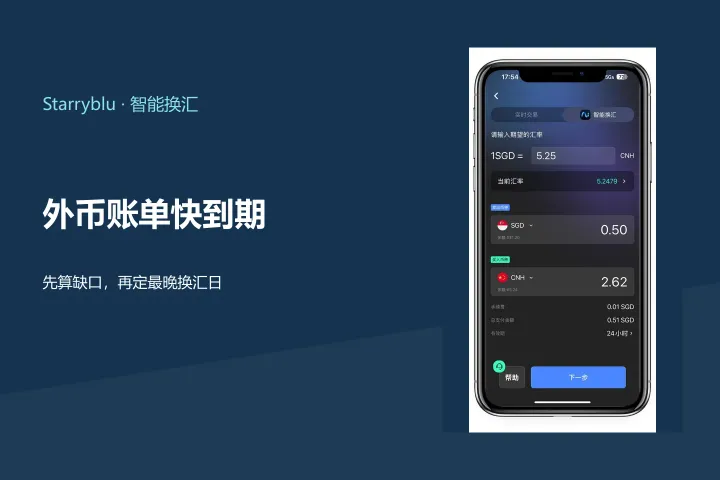
The documented Starryblu China route shows a CNY purchase amount and an SGD payment amount, with the exchange rate connecting them. Its instructions specify an SGD account for this service. This is a payment in one currency funded from a balance in another; it is not evidence that every currency held in a multi-currency account can fund the same checkout.
For an SGD-funded purchase, you do not need to treat the entire trip as a single cash-exchange decision. You can consider the conversion associated with the purchase being made. The restaurant continues to price its meal in yuan, while the amount relevant to your Singapore-dollar budget is the SGD charged for that meal.
There is a trade-off. Converting as you spend leaves later purchases exposed to later exchange rates. Exchanging travel cash in advance fixes the acquisition cost of that cash, but also commits you to holding it. Neither approach guarantees a better rate. They serve different preferences: one prices spending transaction by transaction; the other prepares a fixed amount of cash before it is used.
For someone already holding SGD in Starryblu, the merchant-payment service provides a direct use for that balance at supported checkouts. Someone starting with pounds, euros or another currency has an additional consideration: the cost of obtaining the SGD used by this route. The currency you start with can therefore change whether this is a sensible route for you.

Judge the purchase by its total cost
A favourable-looking exchange rate is only useful if it translates into a favourable amount paid. For an SGD-based customer comparing two ways to settle the same yuan bill, the clearest measure is the complete SGD cost, including any applicable payment, conversion or funding charges.
For example, suppose a CNY 300 purchase costs SGD 56 through one method and SGD 57 through another, with all relevant charges included in each figure. The difference is SGD 1. Those are illustrative numbers, not Starryblu quotes. They show why the amount needed to buy the same thing is more informative than a headline promising a low fee or an attractive exchange rate.
If funding the wallet itself costs money, that also belongs in the comparison. A charge paid before the trip may not appear beside a restaurant payment, but it still affects the cost of using that money. Conversely, a reader who already holds usable SGD should not automatically add an imaginary extra conversion that their transaction does not require.
Promotions need similar care. A voucher available to one account on one date is not a permanent price advantage for every customer. Compare the ordinary cost first, then consider a benefit only when its terms actually cover your account and purchase. A temporary discount can improve one purchase without changing the cost of the next.
The two currencies also serve different purposes after purchase. The yuan amount identifies the price charged by the merchant; the Singapore-dollar amount tells you what the transaction used from your budget. Keeping the original receipt alongside the payment record is particularly useful for a return, an expense claim or a question about the amount charged.
The checkout experience still belongs to the merchant
Starryblu documents both common QR interactions: the customer scans a merchant’s payment code, or the merchant scans a code displayed by the customer. That is why an eligible payment need not look identical at a restaurant counter and a staffed shop till. The equipment and checkout arrangement can differ even when the payment network is the same.
The published instructions require phone location access with the user in China. Location access is therefore part of the payment arrangement to prepare for an in-person visit. The official payment instructions provide the screen-by-screen details for customers who need them.
A separate backup is still useful. A phone can lose power or a particular checkout may need a different payment method. Keeping another option available lets you finish the purchase while reserving the wallet for the transactions it supports.
Where Starryblu fits in your spending plans
The strongest fit is an eligible customer who holds or intends to hold SGD in Starryblu and expects to make ordinary purchases at supported mainland Chinese merchants. There is a specific job for the account: fund those purchases through its merchant-payment connection and assess their cost in the currency being spent.
For a frequent visitor, the assessment extends beyond a single trip. Funding the account and understanding its charges are recurring parts of using it. A familiar wallet that serves supported purchases can be useful over several visits; its suitability still rests on the total cost and the merchants you use, rather than a one-off sign-up benefit.
If you already have a payment arrangement that works well, compare the two using the same purchase amount and all applicable costs. Starryblu’s place in your plans should follow from that comparison: a usable way to pay for the things you came to buy, with a clear understanding of what they cost in SGD.
Explore Starryblu and the services available for your account. Invitation code: MCHB003.

Comments ()